Curses and Blessings of the Covenant
Adults · Lesson 7 · Quarter 4
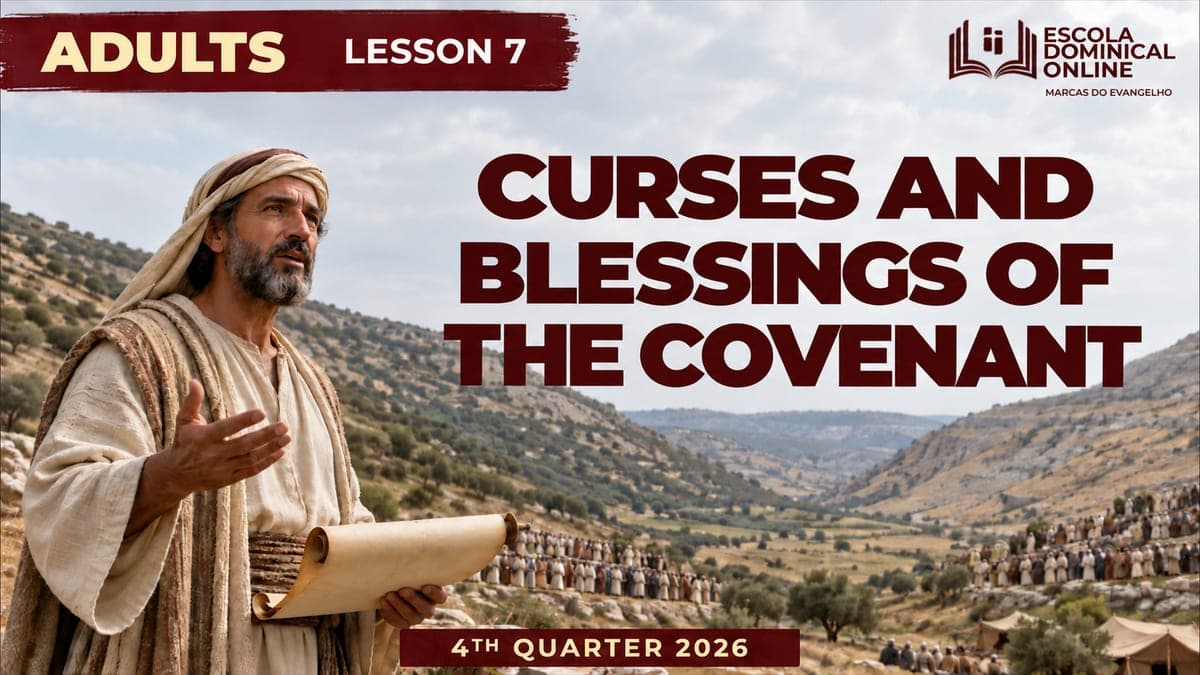
The video has automatic English dubbing. If you hear Portuguese, open the player settings (⚙) → Audio track → English.
About this lesson
Obeying God's voice reveals love and faith, leads to the blessings of the covenant in Christ, and keeps our fellowship with him.
Golden Text
“And it shall come to pass, if thou shalt hearken diligently unto the voice of the LORD thy God, to observe and to do all his commandments which I command thee this day, that the LORD thy God will set thee on high above all nations of the earth:”
Frequently asked questions about this lesson
1.Does Deuteronomy 28 promise financial prosperity to those who are faithful to God?
Not as an individual contract. Deuteronomy 28 is the final part of a covenant between God and Israel as a nation, in a specific land, under a regime in which God governed the people directly. The blessings were collective and speak the language of a farming economy: rain in season, a full barn, the increase of the herds and the flocks (Deuteronomy 28:4). To pull one verse out of that covenant and apply it to someone's paycheck today is to ignore the context and the change of covenant: Christ is "But now hath he obtained a more excellent ministry, by how much also he is the mediator of a better covenant, which was established upon better promises." (Hebrews 8:6). The New Testament shows faithful servants in need, Paul learned "I know both how to be abased, and I know how to abound: every where and in all things I am instructed both to be full and to be hungry, both to abound and to suffer need." (Philippians 4:12), and warns that "But they that will be rich fall into temptation and a snare, and into many foolish and hurtful lusts, which drown men in destruction and perdition." (1 Timothy 6:9). God blesses and cares for the whole of life, but the blessing is grace, not payment. Tithes, offerings or "declarations" are not a mechanism of financial return.
2.Are sickness, unemployment, poverty or being unable to have children a sign of a curse or of a lack of faith?
No. Job was "There was a man in the land of Uz, whose name was Job; and that man was perfect and upright, and one that feared God, and eschewed evil." (Job 1:1), and he lost possessions, children and health; the friends who said he was suffering because of sin heard from God: "And it was so, that after the LORD had spoken these words unto Job, the LORD said to Eliphaz the Temanite, My wrath is kindled against thee, and against thy two friends: for ye have not spoken of me the thing that is right, as my servant Job hath." (Job 42:7). The disciples asked, before a man blind from birth, who had sinned; Jesus answered: "Jesus answered, Neither hath this man sinned, nor his parents: but that the works of God should be made manifest in him." (John 9:3). Paul left Trophimus sick at Miletus (2 Timothy 4:20). Sin has real consequences, and there are moments when the believer himself needs to examine his life before God. But pronouncing the diagnosis over someone else's suffering is the mistake of Job's friends. Prosperity is not a certificate of approval, and the lack of it is not a sentence of rejection.
3.Is there such a thing as a generational curse? Do I need a prayer campaign to break a family curse?
Whoever is in Christ does not live under a curse: "Christ hath redeemed us from the curse of the law, being made a curse for us: for it is written, Cursed is every one that hangeth on a tree:" (Galatians 3:13), and "There is therefore now no condemnation to them which are in Christ Jesus, who walk not after the flesh, but after the Spirit." (Romans 8:1). The idea of a curse that passes automatically from father to son was rejected by God Himself through Ezekiel: "The soul that sinneth, it shall die. The son shall not bear the iniquity of the father, neither shall the father bear the iniquity of the son: the righteousness of the righteous shall be upon him, and the wickedness of the wicked shall be upon him." (Ezekiel 18:20) (see also Deuteronomy 24:16). The text of Exodus 20:5 speaks of iniquity visited upon them that hate Him, generations that go on in the same sin, not of a sentence upon the child who turns to God. Family habits and wounds do exist, and the Gospel confronts them with repentance, discipleship, prayer and help, not with a ritual, a paid chain or a "breaking" that the cross has not already settled. In Christ, "Therefore if any man be in Christ, he is a new creature: old things are passed away; behold, all things are become new." (2 Corinthians 5:17).
4.If a believer sins, does he come back under the curses of Deuteronomy 28?
No. The believer who sins does not go back to the regime of Ebal; he is under the correction of a Father. "For whom the Lord loveth he chasteneth, and scourgeth every son whom he receiveth." (Hebrews 12:6), and He corrects "For they verily for a few days chastened us after their own pleasure; but he for our profit, that we might be partakers of his holiness." (Hebrews 12:10). Correction is not a curse: a curse is a sentence; correction is care. The way for the one who has fallen is confession: "If we confess our sins, he is faithful and just to forgive us our sins, and to cleanse us from all unrighteousness." (1 John 1:9). At the same time, grace does not cancel the sowing: "Be not deceived; God is not mocked: for whatsoever a man soweth, that shall he also reap." (Galatians 6:7). Sin still has consequences and still wounds fellowship with God.
5.What is the New Covenant, and in what way is it better than the one at Sinai?
It is the covenant promised through Jeremiah, "Behold, the days come, saith the LORD, that I will make a new covenant with the house of Israel, and with the house of Judah:" (Jeremiah 31:31), in which God says: "But this shall be the covenant that I will make with the house of Israel; After those days, saith the LORD, I will put my law in their inward parts, and write it in their hearts; and will be their God, and they shall be my people." (Jeremiah 31:33). Jesus inaugurated it with His own blood: "Likewise also the cup after supper, saying, This cup is the new testament in my blood, which is shed for you." (Luke 22:20). Hebrews says it is superior because Christ is "But now hath he obtained a more excellent ministry, by how much also he is the mediator of a better covenant, which was established upon better promises." (Hebrews 8:6), and that "By so much was Jesus made a surety of a better testament." (Hebrews 7:22). The law of Sinai said what to do; the New Covenant, through the Holy Spirit, gives the wanting: "And hope maketh not ashamed; because the love of God is shed abroad in our hearts by the Holy Ghost which is given unto us." (Romans 5:5).
6.Does Hebrews 10:26 mean I lost my salvation because I sinned after my conversion?
The text says: "For if we sin wilfully after that we have received the knowledge of the truth, there remaineth no more sacrifice for sins," (Hebrews 10:26). It speaks of those who despise Christ with their eyes open, those who "Of how much sorer punishment, suppose ye, shall he be thought worthy, who hath trodden under foot the Son of God, and hath counted the blood of the covenant, wherewith he was sanctified, an unholy thing, and hath done despite unto the Spirit of grace?" (Hebrews 10:29), written to people tempted to abandon Christ and go back to the old system. It does not speak of the believer who falls, grieves over the sin and comes back. The Assemblies of God believe that apostasy is real and that it is possible to abandon the faith; that is why Hebrews warns. But whoever is distressed, afraid of having gone too far, has already shown that he does not despise grace. For that person, the door is the one in 1 John 1:9: confess and be forgiven.
Adults
Quarter 4
Scripture quotations: King James Version (KJV) and Berean Standard Bible (BSB), both in the public domain.